Subcribe to our RSS feeds Add to Circles Follow us on Twitter Join Us on Facebook Follow my blog with Bloglovin
Showing posts with label Finance. Show all posts

Wednesday, July 27, 2016

POSB 1.55% Fresh Funds Promotion

1.55% Fresh Fund Promotion

<< Update (5-Aug): The POSB 1.55% promotion is over ! >>

POSB is currently running a 1.55% for 6 months 'fresh funds' promotion. The interest rates of 1.55% is comparable with the best interests rates savings account in the market. The only drawback is that the funds will be ear-marked for 6 months, rendering it unusable for the period. If you have existing spare cash and would like to earn some returns, this promotion would be ideal for you!

Here are some of the important facts:

Promotion Period: 25 July 2016 to 4 August 2016

Fresh Funds Amount: Capped at S$50,000, with no minimum amount required.

Singapore Deposit Insurance Corporation insures this account for up to S$50,000.

Step 1


Open a POSB Fresh Funds Account online by 4 August 2016.

If you have iBanking: Apply via iBanking
-> Apply -> Deposit Accounts -> 'POSB Fresh Funds Account"

If you do not have iBanking: Apply via ATM

- You will have a 'Fresh Funds' Bank Account Number which you can now deposit your S$50K.

POSB Fresh Funds Account

Step 2


Deposit fresh funds* into your POSB Fresh Funds Account by 4 August 2016, 3.30pm.

During the POSB Fresh Funds Account opening process, you will be prompted to select an existing POSB/DBS Current or Savings Account to be used for signature reference. This same account will be used for the crediting of the Cash Gift Interest.

*Fresh funds refers to funds deposited through cheque(s), cashier's order(s), demand draft(s), cash deposits, FAST credit, telegraphic transfer, share payment, IBG funds transfer and MEPS receipt.

POSB Fresh Funds Account


Note: You cannot use cash from existing POSB/DBS accounts. 

Step 3


Maintain the fresh funds deposited in the account for 6 months until 4 February 2017.

Step 4


The Cash Gift Interest will be credited into your reference account by 15 March 2017. Your POSB Fresh Funds Account will thereafter be auto-closed and the funds will be credited into your reference account.

Illustration of interest earned (S$10k and S$50k):


SGD $10,000 x 1.55% p.a. x 184/365 days = SGD$78.14

SGD $50,000 x 1.55% p.a. x 184/365 days = SGD$390.68

It is worthwhile to note that successful customers will receive a confirmation SMS within 5 working days from the point of account opening. So do take note of this SMS and check with POSB if you have done the application steps listed above but did not get a confirmation. It took 1 working day for my fresh fund account to be created. I got my SMS notification on the 2nd working day.
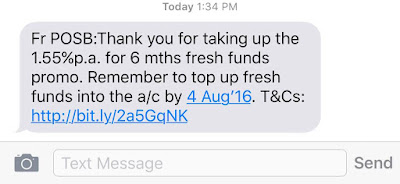
Fresh Fund SMS Notification


Important side note:
Auto-closure of the account will only happen on 15-Mar. To prevent idle funds from sitting in the account (Roughly 39 days), i would suggest to make a trip down to POSB/DBS to close the account after 04-Feb-17.

Happy Saving! 

Thursday, May 12, 2016

Highest Interest Rates Savings Accounts Comparison

For less than S$50-60k,


3.55% pa, BOC Smartsaver
Pros: Highest Interest Rate (Spend $500, Giro salary and Pay 3 bills)
Cons: Bank's web interface is dated

3.25% pa, OCBC 360 (Varies 2.25-3.25%)
Pros: Best for people who spend on dining (365 Card). High Interest Rate (Spend $500, Giro salary and Pay 3 bills)
Cons: Need to invest to get the additional 1%, otherwise interest rate will be 2.25%

3.06% pa, Maybank SaveUp
Pros: Highest Interest Rate  (Spend $500 on Card, Giro salary, Giro $300 payments)
Cons: Credit card not one of the best in terms of rewards

2.43% pa, UOB One
Pros: Highest Interest Rate among Local banks (Spend $500 and Giro salary/3 Giro payments)
Cons: Need to spend consistently using the One Card every 3 months additional yearly rebates up to $200

2.5% pa, Citibank Interest Plus (Not recommended - Due to investment components)
Pros: Highest Interest Rate (Insure, Invest and Spend)
Cons: Need to buy a Citi Insurance, Need to invest in Regular Savings Plan and Spend $25 per month on Credit Card.

Alternatives


2.08% pa, DBS Multiplier
Pros: Best if high income ($20k and above) and do not want the hassle of credit card spends.
Cons: Difficult to reach $20k (Combination of salary, investing and credit card spends per month).

1.55% pa, SCB eSaver
Pros: Best for people with No cc, no Giro, No salary crediting, No min sum, No need for withdrawals.
Cons: Applicable only to Fresh funds / Incremental Balances. ~

1.15% pa, Maybank iSsavy
Pros: Promotional rate of 1.15% for first S$50k
Cons: Applicable only to Fresh funds / Incremental Balances. ~

1.00% pa, CIMB FastSaver
Pros: No gimmicks, flat 1% on first S$50k.
Cons: Not many ATMs, Web interface is dated.

0.88% pa, UOB Uniplus
Pros: Local Bank, Promotional rate of 0.78% for first S$50k
Cons: Applicable only to Fresh funds / Incremental Balances. ~

~ Moving balances between banks once every 2 months, will constitute the monies as fresh funds, enabling you to qualify for the 'Promotional' interest rates.

For any other amounts above S$50-60k*,

1.98% pa, Bank of East Asia (BEA) - Best 1 Year Fixed Deposit
1.80% pa, Maybank iSsavy Time Deposit - Fixed Deposit
1.75% pa, Singapore Savings Bond (May 2016) - Singapore Government Bond
1.70% pa, SCB eSaver - Amounts up to S$200k
1.60% pa, UOB High Yield Account - Amounts up to S$350k
1.40% pa, Maybank iSsavy Savings - Amounts above S$200k
1.28% pa, UOB Uniplus - Amounts from S$100k - 1Mil
1.00% pa, CIMB FastSaver - Savings Account


Realistically, it would not be difficult to get between 1-2.25% on your Savings. Why leave your money idling, in a bank that gives 0.0275% interest p.a, when you can make it work! Hopefully the list above can help you make a choice on some of the best interest rate savings account available in the market today.

Read more on the Best Savings Accounts in 2016.

*Do note that the interest rates promotions may change with time. So do refer to the date that this page is updated.

Last Update: 05-Aug-2016

- Added Maybank SaveUp


Monday, April 25, 2016

The Best Child Development Account (CDA) in Singapore

Hey! If you are here because you are thinking of which bank to open a Child Development Account (CDA), then congratulations! You will soon be welcoming your bundle of joy to this world!


First off, let me explain what the CDA is all about. The Baby Bonus Child Development Account (CDA) is a co-savings scheme, where savings deposited by parents into the CDA are matched dollar-for-dollar by the Government, up to a specified ceiling, depending on the child's birth order. The CDA monies can be used at Approved Institutions (AI), such as Child Care Centres, kindergartens, Hospitals, Clinics, Pharmacies  and Optical shops. 


Yes! You can even use the money for your Pediatrician visits and for Vaccinations.

This article will compare the CDA from each of the 3 local banks and help you make the best choice, to give your child a head-start he/she deserves!


CDA First Step Grant (NEW!)


If your child is born on or after 24 March 2016, he/she is eligible for the CDA First Step grant of S$3,000 (announced on Budget Day 2016). To receive the grant, parents must wait until 1 July 2016 before saving in the child’s CDA. Since the CDA First Step Grant is a government initiative, the benefit is the same across all 3 banks!


1. POSB (Smiley CDA)


Interest Rate: 2% (Up to a max. of S$12,000 for 1st & 2nd Child)
Remaining balance: 0.05%p.a

Others: 

- 2% interest is guaranteed for 5 years
- Baby Bonus NETS Card ( Discounts on various online, retail and dining merchants).


2. OCBC (CDA)


Interest Rate: 2% (Up to a max. of S$36,000)
Remaining balance: 0.05%p.a

Others: 

- 3% Cashback on medical spend, on top of existing benefits with OCBC 365 Credit Card. 
- Discounts with the OCBC Baby Bonus Card at bookstores, optical shops, enrichment courses and other merchants like MindChamps and Kinderland.

3. UOB (CDA)


Interest Rate: 2% (With no deposit cap on all balances)


Remaining balance: N.A

Others:

- Kungfu Panda gift set promotion*


Summary


Regardless of your choice, the CDA is a must to give your child a head-start in life. Whether you intend to use the money for enrichment, education and heathcare (at approved institutions), the government will provide a dollar-for-dollar matching up until the cap, based on the order of your child.


Hopefully this article has helped you in your parenting journey!


Notes:

*Singaporean parents do not need to make a trip to the bank to open a CDA.
*The funds in the CDA cannot be withdrawn in cash.
*All banks will issue a Baby Bonus NETS card to the parents.
Credits: Babybonus


Tuesday, January 19, 2016

Best Savings Accounts in 2016

The New Year has arrived! With all the gloom and negativity about the global economy, rising interests rates and potential financial crisis, i thought it would be a good time to share some of the best savings account in Singapore. So that you can stretch your interest income without experiencing the risks and volatility of other financial products like stocks or REITs.

I have shared my technique on earning that additional 1.0% on my savings. In essence, i move my spare savings around different banks, thereby qualifying it as 'fresh funds', to enjoy the promotional interest rates - which definitely beats leaving it in a traditional savings account.

Since i have benefited from this, i would also highly encourage you to leverage on the current fresh savings deposit promotions in the coming new year and enjoy the promotional interests on your savings now!


1. e$aver Account (Standard Chartered Bank)


The Standard Chartered Bank's eSaver account gives the best interest rates for deposits of fresh funds less than $200,000. Enjoy a 1.5% p.a interest for fresh deposits during the promotion period. 


2. Uniplus Account (UOB)


The 2016 Chinese New Year promotion for Uniplus features a bonus interest rate of 1.0% to 1.4%, depending on the amount of fresh funds deposited and held in the account for the period till 29-FEB-16.

In addition to the bonus interest, you can also enjoy (while stocks lasts) a 24K gold-plated RISIS Bountiful Monkey Figurine* (worth S$238) when you deposit Fresh Funds of S$108,000.

3. iSAVvy Savings Account (Maybank)


For people who are disciplined savers, Maybank iSAVvy Savings Plus Account is a step up savings account that will reward you for consistancy. With this savings account, you will not only earn an interest of 0.30%-0.38% a year but you will also be rewarded with additional interest on interest as high as 6%, credited at the end of the 6th month. 


The current CNY promotion also includes an additional 1% interest on fresh funds. *Do note that the promotion ends on the 31-JAN-16.


4. 360 Account (OCBC)


For those who still haven't opened a 360 Account, 2016 is the time to do so. It is by far the best savings account (Especially if you are an OCBC credit card user) for up to $60,000.


You can refer to our article on the Best Interest Rates products here!.

A Quick Comparison


SCBUOBMaybankOCBC *
<S$50,0001.45%<S$50,0001.10%<S$50,0001.30%Up to $60kUp to 3.35%
S$50,000 to <S$200,0001.50%S$50,000 to <S$100,0001.30%S$50,000 to <S$200,0001.38%
≥S$200,0001.60%≥S$100,0001.40%≥S$200,0001.50%*With conditions


Sunday, September 06, 2015

OCBC Frank Card - Has it lost its edge ?

The OCBC Frank Card was one of my favourite Credit Cards! It allowed me to stretch my dollar from all my online spending. Giving me up to 6% on my online spending and an unlimited cash back of 0.5% on all other spend. It even made it to the list of the best cash back credit cards !

Until this happened. 


Frank SMS
A Frank SMS


Tsk, Tsk. So sneaky. 

Similar to the changes made to the UOB One Card, OCBC has revised some of the cash back rate, sadly it made the card less competitive. 

Let us break down the changes from 1st October.


Frank Cashback Changes


Changes to the cash rebates


1) The main point to note is the removal of the "No Cap on 0.5% rebates". 

This essentially means that once you've hit the S$60 spending rebate from any of the criteria, you will no longer be eligible for more rebates! 

2) Weekend/Weekday Dining, Entertainment rebates, increased to 5% and 3% respectively.

With all due respect, there is already a card for that. Its call the OCBC365. Incorporating this aspect into a pure spending/cashback card simply diminishes the function of the Frank Card. 

3) Minimum spend to earn rebates, reduced to S$400. 

Well its great that they reduce the minimum spend amount. But if you are a financially savvy customer, you would have an OCBC360 account and one of the terms for the OCBC360 additional interest criteria is to spend S$500 on your OCBC credit cards. Reducing the min. spend to earn rebates does not really do much in this case.

4) Minimum spend to exclude Online and Nets Flashpay ATUs spending

This is perhaps the nail-in-the-coffin for this card! If it was already hard to achieve the min. spend amount, especially if the bulk of your spending are from online shopping, then it would be impossible to qualify for the rebates at all!

With this 'hidden' criteria, you would need to spend S$400 from "KTVs, Cinemas, Bars and some cafes" and "everything else" each month, to qualify for rebates.


A Frank Summary


I guess all good things must come to an end. The revision of the terms really makes this card lose out to its cashback peers, like the UOB One Card and the SCB Manhattan card. The only saving grace for the Frank Card is that many holders are also OCBC360 account holders. In any case, i would expect quite an exodus of users from the Frank Card - i myself would be looking at other OCBC rebate Cards (OCBC Cashflo).

Stay tuned for a shoot-out of the latest cash back cards available!


Tuesday, August 18, 2015

UOB One Card, Changes You Need To Know

So here's the deal, UOB One Card will be revising their rebate structure from the 1st October 2015. Before we get into the details, lets take a look at what the UOB One Card rebates used to be, before the impending changes.

UOB One Card Rebates (old)

The UOB One card would give you tiered rebates based on the minimum spending over 3 months. The rebates are listed as S$30, S$80 and S$150, earned quarterly. What this means is that to hit each of the rebate tiers, one must spend at least S$300, S$800 and S$1,500 consistently over 3 months. 

In my opinion, this card is decent for those who consistently charge a fixed amount to their card each month. The penalty for failing to hit the minimum spend on any of the 3 months would cause you to fall to a lower rebate tier or in the worse case, not earn any rebate at all.

So if you had trouble trying to hit any of the 3 tiers, then the bad news is that from 1st October, it is going to be even harder!

However, if you are able to meet the requirement consistently, you will be rewarded with a nice 3.33% cash back. At 3.33%, this is one of the best cash back cards available on the market at the moment. 

Let's take a look at the revised rebate structure for the UOB One Card:

The Changes


UOB One Card Rebates (Old Vs New)

From the 1st October, the minimum tiers are increased to S$500, S$1000 and S$2000 respectively. The payout amount is tweaked slightly at S$50, S$100 and S$300 - effectively rewarding those who spend upwards of S$2000 for each month.

UOB One Card Rebates New 5%

Also, one additional point to note, the 2% overseas cash rebate promotion will no longer apply from October. 

Summary


With the new requirements, those who have no trouble spending S$2000 per month on their One Card will be rewarded with a generous 5% rebate. However if you are like me, finding it hard to hit the S$500 monthly spending tier, it would be an even more uphill task trying to monitor your monthly spending to ensure you qualify for the rebate.

Although the One Card gives one of the highest cash backs in the market, there are still many options available from other banks that have easier requirements and give relatively decent rebates. 

Some food for thought: From a consumer standpoint, making it harder to achieve the rebate amounts simply discourages use of the credit card. 


You can read more about the UOB One Card changes here.


Friday, June 12, 2015

OCBC360 - Earn 2.25% Interest on Your Savings

I had previously discussed the changes to the OCBC360 account and did a mini summary on the differences between the new and old criteria. I also mentioned that it would not be difficult to achieve a 2.25% interest rate that you will earn on your first S$60,000 in the 360 account.

Well, here's how my 360 account fared on the first month of the new criteria. 

OCBC360 Interest Postings

As you can see, the interest credit amounts are broken down into the various components of each posting - so that it is clear and transparent.

360 Save Bonus
360 Save Bonus


360 CC Spend Bonus
360 CC Spend Bonus

360 Payment Bonus
360 Payment Bonus

360 Salary Bonus 
360 Salary Bonus


If you haven't already opened an OCBC360 account, i would recommend that you do. In my opinion, it is the best savings account in the market right now for your first S$60,000. 

For those who have difficulties meeting the criterias above, you can look at some of the savings account offerings from Standard Chartered and UOB. These banks do give a relatively decent interest rate of about 0.9-1.5%* on your savings without any caveats.

*(Depending on your deposit amount)

FAQ on the 360 Account:

When will my special interest be credited to my account ?

OCBC credits the special interest amounts on the 7th working day.


Will i still get my special interest if the money is transferred out of the account before the 7th ?

Yes, the interest accrued is based on the previous month's daily balances.


Does payments of 2 different credit cards to the same bank count?

Yes, each credit card payment will count as a unique payment and will contribute to fulfilling the "Payment Bonus" requirements.


Does the "Save Bonus" apply to my total balance or only on the increment?

The 1% Save Bonus will only be applied on the incremental balance, which is the difference between the current month average daily balance and previous month. (up to $1,000,000.)


Why don't i qualify for the "Salary Bonus" ?

Only salary credits with the transaction reference "GIRO-SALARY" and amounts more than S$2000 will qualify.


Wednesday, May 13, 2015

Singapore Savings Bond - A Risk Free Investment Option

The Singapore Savings Bond (SSB) is a specialized investment product, which will likely be launched in the 2nd half of 2015. It forms part of the plan by the government to make low-cost (and low risk) government Bonds available to retail investors like you and I.

The concept of the Singapore Savings Bond interest rates will be linked to the long-term Singapore Government Securities (SGS) rates. But unlike SGS bonds, which pay the same interest rates every year, the Savings Bond will start with smaller interest rates that will keep rising. The longer you hold the bond, the higher your return.

One of the most interesting feature of this investment product is that a bondholder can get his money back in any month, with no penalty imposed. Unlike a regular bond or a fixed deposit, this gives an added dimension of liquidity for the bond holder. 

Another key design of the bond is its non-tradable aspect. This feature protects the individuals from potential capital losses in the secondary markets, making it a fairly safe and low risk investment.

Let's take a look at some of the important facts of the Singapore Savings Bond with this infographic.

SSB - All You Need To Know


Other Features:

Who can buy
- Individuals only (Like You and I).

Term
- 10 years.

Method Of Payment
- Cash, the Government will consider allowing SRS or CPF to purchase in the future.

Interest
- Paid every 6 months (Twice a year).
- At issuance, rates are fixed based on the prevailing SGS yields and locked in for each issue.

Issuance
Monthly. Allocated via balloting of units if oversubscribed.

Redemption
Monthly, with no penalty. 
Principal and any outstanding accrued interest will be paid on redemption. 
You will always get your principal amount back in full.

When will the Savings Bond be available
- It will likely be launched in the second half of 2015.

Summary


I would recommend this product for the less savvy investors who would like to achieve any of the following investment objectives:

1. Protect themselves against inflation (Although not particularly great).

2. Balance their investment portfolio.

3. Long-term savings option at a low risk (Saving for a 'rainy day').

After all, there aren't many (or any) investment products that provide principal protection. Backed by solid governance, financial stability and a diversified economy, our sovereign debt is only one of the 9 countries in the world with a AAA rating from all rating agencies.


Thursday, April 30, 2015

OCBC360 - It Just Got Better

Did the OCBC360 Account "Just Got Better" or are there really better savings account alternatives out there to maximise your interest returns. Lets take a look at whats new, come 1st May.


The current OCBC360 terms:


Lets take a look at the new criterias come 01-MAY-2015:

Lets discuss the criterias from the left-to-right. To prevent confusion, we will number them 1 to 5.


New Terms


1) 1.2% Per Year 

Credit your salary of at least S$2,000 through GIRO

How to earn the bonus interest:

- Credit your salary of at least S$2,000 per month.

- You will receive this bonus interest by the 7th business day (exclude Saturday, Sunday and Public Holiday) of the following month.

- Only salary credit with the transaction description "GIRO-SALARY" will qualify for this bonus.

Our take:

Previously: 1.0% Per Year

There was an upward revision of the interest by 0.2% per year. This is great news for everyone, as this criteria is probably the easiest to meet.

2) 0.5% Per Year

Pay any 3 bills online or through GIRO

How to earn the bonus interest:
- Make 3 unique bill payments from this account with OCBC Online Banking using Pay Any Bill and Pay Any Card services or through GIRO.

- Multiple payments to the same bill within the calendar month will be considered as a single payment.

- You will receive this bonus interest by the 7th business day (excluding Saturday, Sunday and Public Holiday) of the following month.

Our take:

Previously: 1.0% Per Year

This criteria has seen its interest amount reduced from 1% to 0.5%. 

An additional option of Giro payments, has been added to make it easier to qualify for this bonus interest. However, the huge reduction will significantly affect the final bonus interest amount.

3) 0.5% Per Year

Spend at least S$500 on OCBC Credit Cards

How to earn the bonus interest:
- Spend at least S$500 in total across your personal OCBC Credit Cards such as 365, Titanium, Platinum, FRANK, Robinsons, Plus! and Best Denki.

- You will receive this bonus interest by the 7th business day (exclude Saturday, Sunday and Public Holiday) of the following month.

Our take:

Previously: 1.0% Per Year

Similar to criteria 2, the bonus interest amount is reduced from 1% to 0.5%. 

Also, it is worthwhile to note that the minimum spend criteria has been increased from SGD$400 to SGD$500, making it slightly more difficult to reach this criteria - especially for account holders who rarely use OCBC credit cards.

4) 1% per year

Insure or invest and get this bonus for 12 months

How to earn the bonus interest: 
- Purchase any eligible financial product of at least the minimum amount, such as Endowment of at least S$8,000 in annual premium, or investment products such as Unit Trust or Structured Deposits of at least S$40,000.

- If you make multiple purchases of eligible financial products within the same month, we will only combine purchases of the same product type which have passed 14 days after the product’s effective date. Effective date refers to the inception date of the insurance plan, trade date of unit trust, deposit start date of structured deposit and transaction date for other investment products.

- This bonus interest is paid for 12 months after the free cancellation period or 14 days, whichever is longer.

Our take:

This is a new component of the OCBC360.

We feel that this additional 1% would not be easy to achieve unless the account holder is interested to purchase a financial product from OCBC. Moreover, do note the minimum amount of the investment required to qualify for this bonus interest.

5) 1% per year

Increase your account balance from the previous month’s balance

How to earn the bonus interest:

- Incremental account balance is the difference between current and previous month’s account balance.

- This bonus interest will be paid on incremental account balance of up to S$1,000,000.

- You will receive this bonus interest by the 7th business day (excluding Saturday, Sunday and Public Holiday) of the following month.

Our take:


This is a brand new component of the OCBC360. Allowing account holders to earn an additional 1% on incremental balances. This means that the additional 1% will be credited on your incremental balance. (Eg: $5000 x 1/100 x 31/365)

Illustration below:

MonthBalanceIncremental BalanceBonus Interest earned on eligible Incremental Balance
Nov-14S$60,000S$0.00
Dec-14S$65,000S$5000S$4.25

This works similar in effect to the OCBC Bonus+ Savings Account

We feel that the additional 1% is great only if one has a consistent stream of additional income or savings. Otherwise, the 1% bonus on the month-on-month incremental balances would not give substantial return.

We do see an opportunity of moving funds on alternate months to leverage on this additional 1% - similar to our Supercharge your savings article. But it remains to be seen if it will work with the OCBC360.

Unchanged Terms


Lastly, on top of the bonus interest, you will still continue to earn a base interest of 0.05% per year on your entire account balance.

Summary


The new OCBC 360 conditions sure gives us a lot to consider. Besides revising some bonus interest downwards, they have introduced two new components. and revised certain criterias.

All else equal, if you had managed to meet the previous criteria and achieved 3.05%, you will now only qualify for an effective interest of 2.25%. If you manage to meet criteria 4 (Insure or Invest) and criteria 5 (Incremental Balance). 

You will probably enjoy more interest returns from the latest changes to the OCBC360 Savings Account - to the tune of > 3.25% in EIR. This is pretty good considering that the CPF (Supposedly Risk Free) returns is at 2.5% for your ordinary account.

However, if you are like me, unable to meet some of these criterias, why not take a look at the latest UOB One Account - which provides an EIR of 2.43%. Not too shabby for a savings account.

Monday, April 27, 2015

UOB One Account - A Worthy Replacement of OCBC360

If you are looking to maximize your savings and worried about the impending changes to your OCBC 360 account (Which may effectively reduce its return to about 2.05%), perhaps you can consider the newly launched "UOB One Account". Lets take a look at the requirements to enjoy the interest rates as advertised by UOB.


UOB One Account
Image Credit: Shutterstock


The Deal

To qualify for the high savings interest for the UOB One Account, you would be required to meet the basic criterias listed below:

1. Usage of Credit Cards
- A minimum charge of $500 to the UOB One Card or UOB Direct Visa Debit Card.
2. Salary or Giro
- To credit your salary (min. of $2000) per month
OR

- Perform 3 GIRO debit transactions

The Savings Interest Rates on meeting the above criterias are as follows:


Account Balance in your UOB One AccountMeet Card Spend of S$500Meet Card Spend of S$500 and Credit Salary / make 3 GIRO debit transactions
First S$10,0001.00%1.50%
Next S$20,0001.50%2.00%
Next S$20,0002.00%3.33%
Above S$50,0000.05%0.05%


^ Maximum effective interest rate (EIR) on the One Account is 2.43% p.a. at S$50,000 deposit, provided customers meet both criterias of S$500 Card Spend and S$2,000 Salary credit or 3 GIRO debits per month.


Summary


Whilst the criteria set by UOB is simple enough to achieve, especially for existing holders of the One Card, the actual Effective Interest Rate (EIR) actually falls short of the headlined 3.33%. In fact, the total EIR comes up to 2.43% on your $50,000. Although it is not be as attractive as the 3.05% that OCBC 360 used to promise, it certainly will be; come 1st May, when OCBC revises that figure.

You can read more about the impending changes to OCBC360 here: Other Alternatives to the OCBC 360

Saturday, April 11, 2015

What You Need To Know About CompareFIRST

CompareFIRST is an interactive web portal that allows regular people (like you and I) to quickly compare the premiums and features of similar life insurance products offered by different insurance companies in Singapore. 


Insurance
Credit: Shutterstock

Quick and Easy Comparison


Its main objective is to help potential buyers of insurance products make better informed decisions on pricing and coverage of the plans offered by insurance companies. 

Upon making your comparisons and deciding on an insurer, one can proceed to the customer service counters or websites of the life insurance company to make a direct purchase of the policy, more commonly known as DPI (Direct Purchase Insurance).

Alternatively, you can also contact your financial adviser for more detailed understanding of the plans or simply to align with your current financial objectives.


Informational


CompareFIRST does not distribute nor sell the insurance in proxy for the insurers. You will be required to go directly to your desired insurance company to make your purchase. 

It is however, a great platform for you to do some 'shopping'. This will allow you to have a proper feel of the products available in the market.


Direct Purchase Insurance (DPI)


As of 7 April, prospective customers can purchase DPI from customer service counters or websites of life insurance companies. Since DPI are sold without financial advice, their premiums are slightly lower than comparable life insurance products. This is mainly because of the removal of the commission component that is usually paid to the financial adviser.

More information on DPI can be found at the MoneySENSE website. 


Using the Webportal


Browse to the CompareFIRST webpage. Select the product which you are interested, from the choices (DPI, Term Life, Whole Life, Endowment or ILP).


Search

Fill in the mandatory details that will allow the system to generate the necessary insurance plan (Sex, Age, Sum Assured).

Select the sort order (We suggest to sort by Lowest to Highest Premium). Choose the insurance companies that you would like to compare (up to a maximum of four).


Choose for comparison

Compare the plans in detail, export into PDF or Print a hard copy. This will allow you to make an informed decision on which insurer's plan would suit your needs.


Summary


Buying a Term or Life Insurance would no longer be a daunting task with the launch of CompareFIRST. With an intuitive and easy to use interface, comparing insurance plans between the various insurers is a breeze. Whilst having a personal financial adviser has its benefits, buying direct via DPI would also cut down on additional costs related to commissions. This is a great alternative for those looking to buy a policy and yet save some money.
